Quantum Aero unveils Quantonomy and QuantumCore autonomy solutions at UMEX 2026
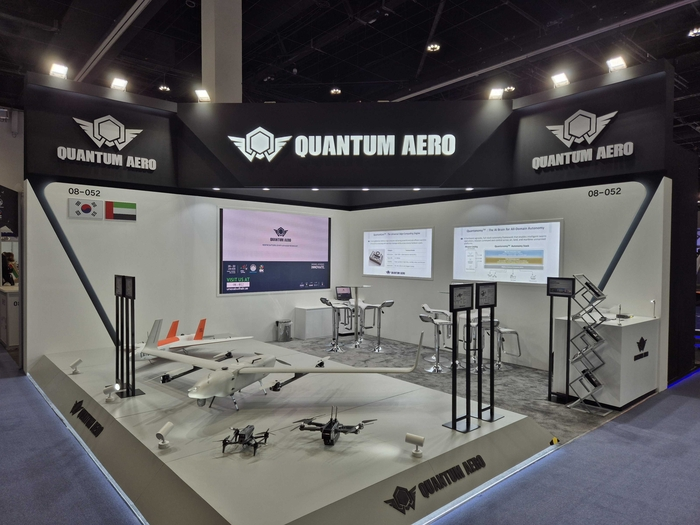
Quantum Aero's booth at UMEX 2026, Abu Dhabi National Exhibition Centre, January 20–22.
At UMEX 2026 in Abu Dhabi, Quantum Aero presented its AI mission-autonomy software and high-performance edge computer, and a Korean approach to the global unmanned-systems market.
Quantum Aero, a defense-AI startup, took part in UMEX 2026, the Middle East's largest unmanned and autonomous systems exhibition, held January 20–22 at the Abu Dhabi National Exhibition Centre (ADNEC), where it unveiled its core technologies, Quantonomy™ and QuantumCore™.
Under the theme “Autonomy: the game-changer of the future battlefield,” the company showcased proprietary technology for making unmanned systems intelligent, drawing strong interest from defense officials worldwide. The solutions are the fruit of aggressive R&D investment and a major hiring push the company has sustained since last year.
The brain and heart of an unmanned aircraft
Quantonomy, Quantum Aero's headline exhibit at UMEX 2026, is an AI mission-autonomy software solution that runs on a range of unmanned platforms to carry out autonomous missions. It perceives complex battlefield conditions in real time, decides optimal flight paths on its own, and performs demanding tasks such as target identification and coordinated multi-aircraft engagement. Its key strength is uninterrupted operation through vision-based navigation even where GNSS (satellite positioning) signals are denied.
QuantumCore, unveiled alongside it, is the high-performance edge computer that runs the Quantonomy engine reliably. Processing large volumes of imagery and sensor data onboard in real time, it creates an ultra-low-latency decision-making environment, letting an unmanned aircraft judge and act independently without a cloud connection.
A heterogeneous swarm ecosystem with Korean drone makers
Alongside its own AI, Quantum Aero proposed a “heterogeneous swarm autonomous-control” solution built with leading Korean drone manufacturers. It integrates dissimilar drones (fixed-wing, multicopter, and loitering munitions) under a single ground control station (GCS).
When an operator enters a mission, Quantum Aero's technology automatically translates it into behavior instructions suited to each airframe. A reconnaissance drone detecting a target can trigger an immediate response from a strike drone, a “recon-to-strike” mission chain run from one GCS. By combining Korea's strong drone hardware with Quantum Aero's AI software, the approach presents a Korean-built unmanned system to the global market.
A Physical AI Verification Hub and cost-efficient infrastructure
Quantum Aero also revealed an AI data-center infrastructure strategy pursued with the AI-software company Moreh. At its center is a “Physical AI Verification Hub” that simulates, trains, and validates AI autonomous-flight technology in a virtual environment.
Built on Moreh's high-efficiency AI software stack, the solution sharply reduces dependence on NVIDIA-centric infrastructure while cutting adoption and operating costs by roughly 60–70%, demonstrating to the global market the feasibility of an independent supply chain for Korean AI autonomous flight.
As the U.S. and China compete for technological primacy, the UAE and other Middle Eastern states are actively diversifying their supply chains to avoid over-reliance on any single country. In that geopolitical context, Quantum Aero's autonomy solutions are being regarded as a trustworthy “Korean alternative.”
Taking part in UMEX 2026 is an important milestone confirming that Quantum Aero's AI pilot technology has reached a global level.Dongkeun Jeon, Chairman of the Board
Jeon added that with a Korean AI autonomous-flight solution matched to the strategic needs of the UAE and the wider Middle East, the company will help set a new standard for the global unmanned-systems market.
Quantum Aero is an advanced unmanned-platform company innovating future mobility and defense solutions through the fusion of AI and unmanned aviation. Building on a technology partnership with Shield AI of the United States, it delivers world-class autonomous unmanned-aircraft solutions and, through its own research lab, focuses on developing a proprietary AI flight-control system.